
A newborn’s stomach makes a lot of noise for something so small. Grunts, squeaks, little groans in the middle of the night — most of it comes down to one thing: gas. It sounds simple, but for a baby whose digestive system is only weeks old, that gas can be genuinely uncomfortable, and it shows.
The good part is that most of this settles on its own within the first few months, as your baby’s gut catches up to the rest of their body. Until then, there’s a lot you can do in the meantime. None of it requires special equipment or a trip to the store.
Below are ten simple, low-effort ways to ease a gassy newborn, pulled from what pediatricians actually recommend to new parents. Some you can do in thirty seconds. Others just mean adjusting how you already feed or hold your baby.
- 1. Bicycle Legs Move
- 2. Tummy Time on Purpose
- 3. The "I Love You" Belly Massage
- 4. Hold Baby Belly-Down (Football Hold)
- 5. Feed Baby Upright, Not Flat
- 6. Slow Down the Bottle
- 7. Burp Mid-Feed, Not Just After
- 8. Try Simethicone Gas Drops
- 9. A Warm Bath Can Loosen Things Up
- 10. Feed Before the Crying Starts
- What to Know Before Baby Outgrows the Gas Phase
- Frequently Asked Questions
1. Bicycle Legs Move

Lay your baby on their back and gently move their legs in a slow pedaling motion, as if they were riding a tiny bicycle. This puts light pressure on the belly and helps push trapped air through the intestines. It works best a little while after a feeding, once your baby has had a chance to digest, and it’s gentle enough to do several times a day without any risk of overdoing it.
2. Tummy Time on Purpose

Tummy time isn’t just for building neck and shoulder strength — it also happens to be one of the simplest gas remedies around. When your baby lies on their stomach, the natural pressure against their belly can help break up gas bubbles and move things along. A few minutes at a time, done while your baby is awake and alert, is enough to make a difference.
Keep a couple of toys nearby to hold their attention.
Short sessions spread through the day tend to work better than one long one.
3. The “I Love You” Belly Massage

This one has a name because it traces the shape of the letters I, L and U across your baby’s stomach, and it follows the actual path of the intestines as it goes. Start on the lower right side of the belly, trace a line up toward the ribs for the “I,” then move across the top of the belly for the “L,” and finish with a curved stroke down the left side for the “U.” Use light, slow pressure with your fingertips, and try it about twenty minutes after a feeding when your baby’s stomach isn’t too full.
4. Hold Baby Belly-Down (Football Hold)

Sometimes called the belly hold or forearm hold, this position has your baby lying face-down along your forearm, with their head resting in your palm and their tummy pressed gently against your arm. The slight pressure on the stomach can ease trapped gas, and a lot of babies find the position soothing on its own, gas or no gas.
It also happens to free up your other hand, which is a small but real win during a fussy stretch.
5. Feed Baby Upright, Not Flat

Gravity does more work here than people expect. When a baby feeds lying flat, milk and air tend to mix together on the way down, which means more gas by the end of the meal.
Tilting your baby to a more upright angle — whether you’re breastfeeding or using a bottle — lets milk settle to the bottom of the stomach while air rises to the top, where it’s easier to burp out. This one change alone can noticeably cut down on fussiness after a feeding, according to several pediatric sources.
Keep that same upright position for ten to fifteen minutes after the feeding ends, too.
6. Slow Down the Bottle
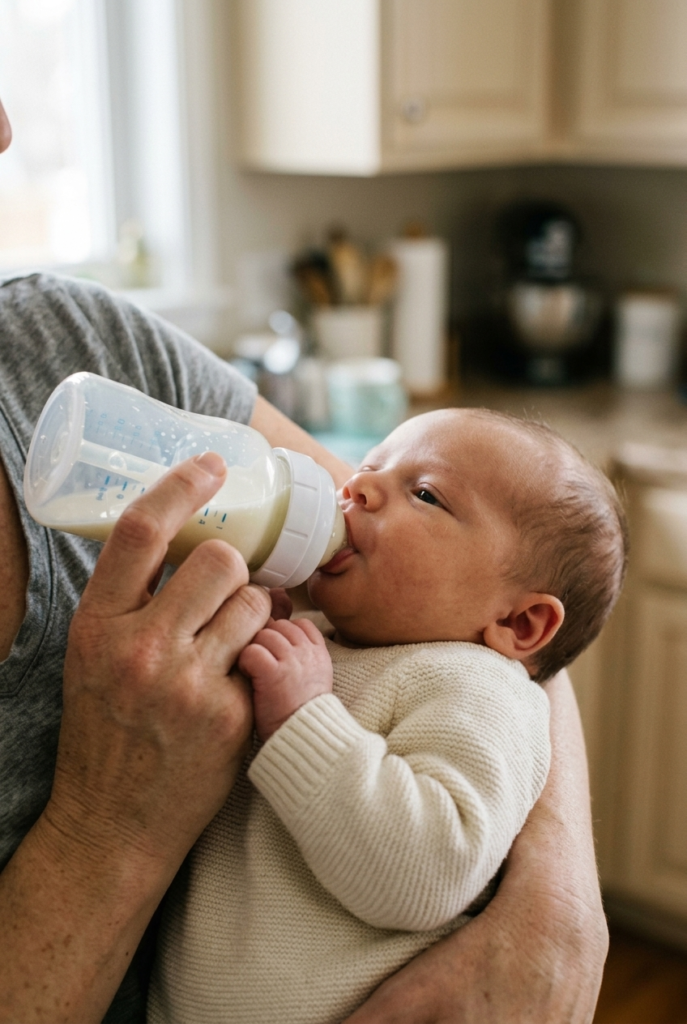
A nipple that flows too fast forces your baby to gulp, and gulping means swallowing extra air along with the milk. If you’re bottle-feeding, look for a slower-flow nipple, or try an angled or vented bottle designed to cut down on air intake. It may take some trial and error to find the right one, since every baby feeds a little differently, but the difference in comfort afterward is often worth the experimenting.
7. Burp Mid-Feed, Not Just After

Most parents burp their baby once, at the very end of a feeding. That’s a good habit, but it’s not the only moment that matters.
Pausing halfway through a feeding to burp — especially with bottle-fed babies — gives trapped air a chance to escape before it has a chance to build up further. Try switching sides if you’re nursing, or pausing every couple of ounces with a bottle, and burp again once the feeding wraps up. Two or three shorter burping breaks tend to clear more air than one long attempt at the end.
8. Try Simethicone Gas Drops

Simethicone drops are the ingredient most pediatricians point to when parents ask about over-the-counter gas relief.
They don’t get rid of gas directly.
Instead, they work by breaking large gas bubbles into smaller ones that pass through the digestive system more easily, which tends to ease the discomfort fairly quickly. A few things worth knowing before you try them:
- Check with your pediatrician on dosing before the first use
- Give the drops directly or mix into a small amount of milk
- Look for versions free of dyes and artificial flavors
- Effects are usually noticeable within a few minutes
9. A Warm Bath Can Loosen Things Up

Warm water relaxes muscles, and a baby’s stomach muscles are no exception. A short, warm bath can ease general fussiness while also helping gas move through the belly more comfortably, especially if your baby has been extra tense or crying for a while.
Try gently massaging the belly in slow, circular motions while your baby is in the water, or right after, while their skin and muscles are still warm. Some parents find this combination works better than either the bath or the massage on its own, likely because the warmth makes the muscles more receptive to the pressure.
10. Feed Before the Crying Starts

This last one is more about timing than technique. A baby who’s been crying from hunger for several minutes tends to gulp frantically once feeding finally starts, and frantic gulping means more swallowed air. Watching for early hunger cues — smacking lips, rooting, sucking on hands — and starting the feeding before the crying escalates can quietly prevent a good amount of gas before it ever builds up.
What to Know Before Baby Outgrows the Gas Phase
Most of what’s covered here isn’t about fixing something broken — it’s about giving your baby’s digestive system a little extra help while it finishes developing. That process usually wraps up somewhere between four and six months, and for most babies, the fussiness fades right along with it.
Until then, a little patience goes a long way. Some days these tricks will work in minutes, other days your baby just needs to cry it out for a bit, and both are completely normal parts of this stage.
Frequently Asked Questions
Q: How do I know if my baby’s crying is from gas or something else?
A: Gas-related crying usually comes with grunting, arching the back, pulling the legs up toward the belly, or a red, strained face. If your baby is feeding well, gaining weight, and having normal bowel movements alongside the fussiness, it’s most likely gas rather than a bigger problem.
Q: How often should I burp my baby during a feeding?
A: For bottle-fed babies, aim for a burping break every two to three ounces. For breastfed babies, burp when switching sides, then again once the feeding ends.
Q: Are gas drops safe for newborns?
A: Simethicone drops are generally considered safe and are the most commonly recommended over-the-counter option, though you should confirm dosing with your pediatrician before the first use.
Q: Can breastfeeding moms do anything to reduce their baby’s gas?
A: Some babies react to certain foods in a nursing mother’s diet, like dairy or cruciferous vegetables, though this varies quite a bit from baby to baby. Talk to your pediatrician before cutting out entire food groups.
Q: Is it normal for gas to get worse before it gets better?
A: Yes. Many babies have a fussier stretch around six to eight weeks as their digestive system is still catching up, and it typically eases after that.
Q: When should I actually call the pediatrician about gas?
A: Reach out if gas is interfering with sleep, feeding, or bowel movements, or if you notice blood in the stool, a fever, or unusual lethargy alongside the fussiness.
Q: Does switching formula actually help with gas?
A: For some babies, yes — a gentler or partially broken-down formula can ease digestion. This should be done with your pediatrician’s guidance rather than through trial and error on your own.
Q: How long does newborn gas typically last?
A: Most babies see significant improvement by four to six months, though a smaller number continue to need some extra help with gas for closer to a year.