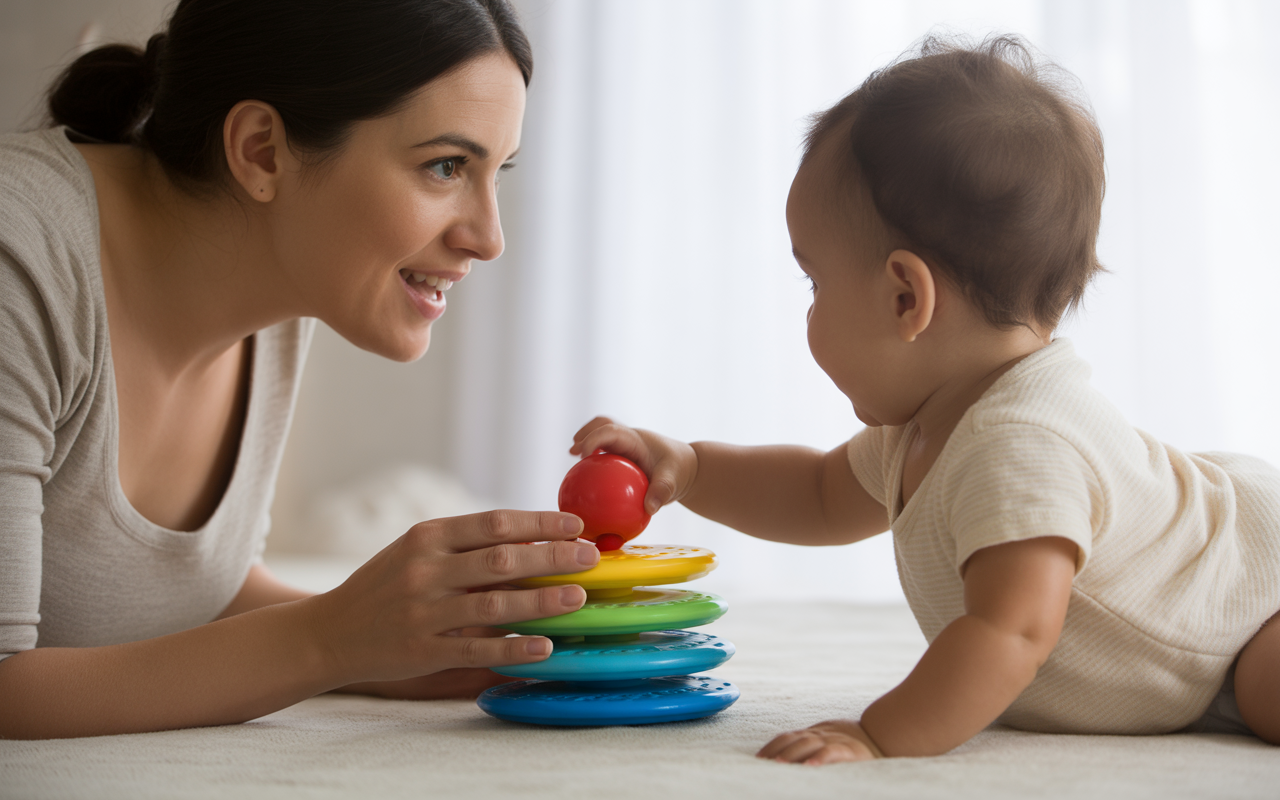
Your baby’s brain grows faster in the first two years than at any other time in life. Every coo, every smile, and every reach for a toy represents millions of neural connections forming. Understanding these mental milestones helps you know what to expect and how to support your little one’s growth.
Cognitive development covers how babies learn, think, and solve problems. From birth to age two, your child will progress through distinct phases of mental growth. Each phase builds on the previous one, creating a foundation for all future learning. These aren’t just random changes. They follow a predictable pattern that researchers have studied for decades.
Babies develop at their own pace, but most hit similar markers around the same ages. Some skills emerge quickly while others take months to master. What you see as simple play—dropping a spoon, hiding behind hands, or banging blocks together—is actually complex brain work. Below, you’ll find a breakdown of six key phases in your baby’s cognitive growth, what to expect during each period, and how these mental skills shape their understanding of the world.
- 0-3 Months: Early Discovery Phase
- 4-6 Months: Sensory Integration and Cause and Effect
- 7-9 Months: Object Permanence Development
- 10-12 Months: Problem Solving and Memory
- 13-18 Months: Symbolic Thinking Emerges
- 19-24 Months: Advanced Problem Solving
- Your Child's Cognitive Path Forward
- Frequently Asked Questions
0-3 Months: Early Discovery Phase
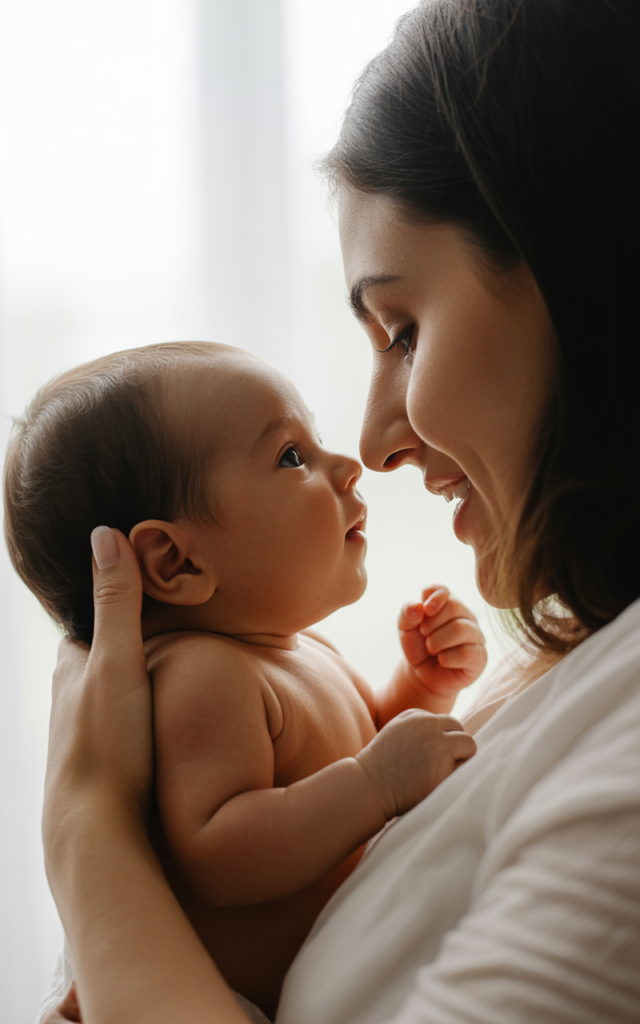
Your newborn enters the world ready to learn. From day one, that tiny brain is processing everything it encounters. Babies at this age focus on basic survival skills while building their first understanding of their surroundings.
Recognition and Response
During these first weeks, your baby learns to recognize familiar faces and voices. She can tell the difference between you and a stranger by the second month. This recognition skill is more advanced than many people realize. Your baby also starts connecting actions with results. She discovers that crying brings you running, and this teaches her about cause and effect in its simplest form.
Sensory Processing
Newborns take in information through all their senses. They’re particularly drawn to high-contrast patterns and human faces. By two months, your baby can track moving objects with her eyes. She’ll turn toward sounds and show interest in new things. This sensory processing lays the groundwork for more complex thinking later.
Anticipation Skills
Around the three-month mark, babies begin to anticipate what comes next. Your little one might start sucking motions at the sight of a bottle. She may smile before you pick her up for feeding time. These anticipation behaviors show memory is forming. Your baby is learning patterns and expecting familiar sequences.
The brain at this stage is like a sponge. Every interaction matters. Simple activities like talking, singing, and making eye contact help build neural pathways. Your baby doesn’t need fancy toys or elaborate activities. She needs consistent, loving interaction with you.
Communication Begins
Even without words, your baby is communicating. Different cries mean different things. A hunger cry sounds different from a tired cry. By month three, cooing sounds start to appear. These early vocalizations are your baby’s first attempts at conversation. She’s testing out her voice and learning that sounds get responses.
Vision improves dramatically during this period. At birth, babies can only see about eight to twelve inches away. By three months, they can see across a room. This expanded vision opens up a whole new world to study and understand.
Building Trust
These early months are about building trust and security. Your baby is learning that her needs will be met. This foundation of trust supports all future cognitive development. A secure baby is more confident to learn and grow.
4-6 Months: Sensory Integration and Cause and Effect

The second quarter of your baby’s first year brings noticeable changes in how she thinks and interacts with objects around her. Her vision sharpens considerably. She can now combine what she sees with what she touches, hears, and tastes. This sensory integration marks a major leap forward.
Experimenting with Actions
Your baby becomes a little scientist during these months. She’ll kick her mattress and watch the mobile shake. She discovers that shaking a rattle produces sound. Then she’ll repeat these actions over and over. This repetition isn’t random. She’s testing theories about how things work.
Dropping things becomes a favorite activity. Your baby will toss toys from her high chair repeatedly. This can seem frustrating to you, but it’s important learning. She’s studying gravity, distance, and your reactions. Each drop teaches her something new about cause and effect.
Hand-Eye Coordination
Reaching and grasping improve significantly. Your baby can now grab objects deliberately. She brings things to her mouth to learn about them through taste and texture. Her hands become tools for learning. She’ll transfer objects from one hand to the other, shake them, bang them together.
These hand movements aren’t just physical development. They’re cognitive work. Your baby is learning about object properties. Is it hard or soft? Does it make noise? Can she squeeze it? Each interaction builds her understanding of the physical world.
Memory Development
Memory takes a big step forward around four to six months. Your baby starts to remember people she hasn’t seen for a while. She might show excitement when a grandparent visits. She recognizes her favorite toys and may look for them if they disappear. This growing memory allows her to make predictions about what comes next.
Social Learning
Your baby becomes more social during this period. She’ll laugh at funny faces and sounds. She responds to her name. She might cry when you leave the room. These social responses show cognitive growth. She understands that people and things exist independently from her.
Below are some key cognitive abilities developing during this stage:
Intentional Movement: Your baby reaches for objects on purpose, not by accident.
Sensory Combination: She connects sights, sounds, and textures to form complete experiences.
Pattern Recognition: She starts to notice routines and anticipate what happens next.
Object Interaction: She learns that different actions produce different results.
7-9 Months: Object Permanence Development

A major cognitive breakthrough happens during these months. Your baby begins to understand that things continue to exist even when she can’t see them. This concept, called object permanence, changes how she thinks about the world. Before this, out of sight truly meant out of mind.
The Peekaboo Phase
Peekaboo becomes hilarious now because your baby grasps the concept. She knows you’re still there behind your hands. She anticipates your reappearance. This simple game is actually advanced cognitive work. It proves she can hold mental images of things not currently visible.
When you hide a toy under a blanket, she’ll lift the blanket to find it. This search behavior shows sophisticated thinking. She must remember the toy exists, remember where it went, and plan actions to retrieve it. Each piece requires mental processing that wasn’t possible just weeks ago.
Increased Curiosity
Your baby becomes intensely curious about her environment. She’ll open drawers, pull things out of containers, and explore every accessible space. This isn’t mischief. It’s cognitive development in action. She’s learning about spatial relationships, cause and effect, and how different objects behave.
She starts to understand that actions have specific results. Push a button and music plays. Drop food and the dog appears. These connections show increasingly complex thinking. She’s building a mental model of how her world works.
Advanced Memory
Memory continues to strengthen. Your baby remembers games you played yesterday. She recalls where you keep her favorite toys. She might crawl to the kitchen when she’s hungry because that’s where food comes from. These memory-based behaviors show cognitive growth.
Language Foundation
Though she’s not talking yet, language comprehension is growing. Your baby understands simple words like “no” and her own name. She might wave bye-bye or clap when excited. These gestures show she’s connecting words with meanings.
Problem-Solving Emerges
Basic problem-solving begins during this stage. If a toy is out of reach, your baby might try different strategies to get it. She might stretch, scoot closer, or even call for help. This strategic thinking represents advanced cognitive processing.
Your baby learns through trial and error. She’ll try the same action multiple times, adjusting her approach based on results. This is her first experience with the scientific method. Test an idea, observe results, modify the approach.
Imitating Behaviors
Imitation becomes more sophisticated. Your baby copies simple actions like clapping or waving. She might pretend to drink from a cup or hold a phone to her ear. These imitations show she’s observing, remembering, and reproducing behaviors she sees.
Social cognition develops alongside these other skills. Your baby reads facial expressions and responds to emotions. She might cry if you look upset or smile when you’re happy. This emotional awareness is a cognitive skill that helps her navigate social situations.
10-12 Months: Problem Solving and Memory
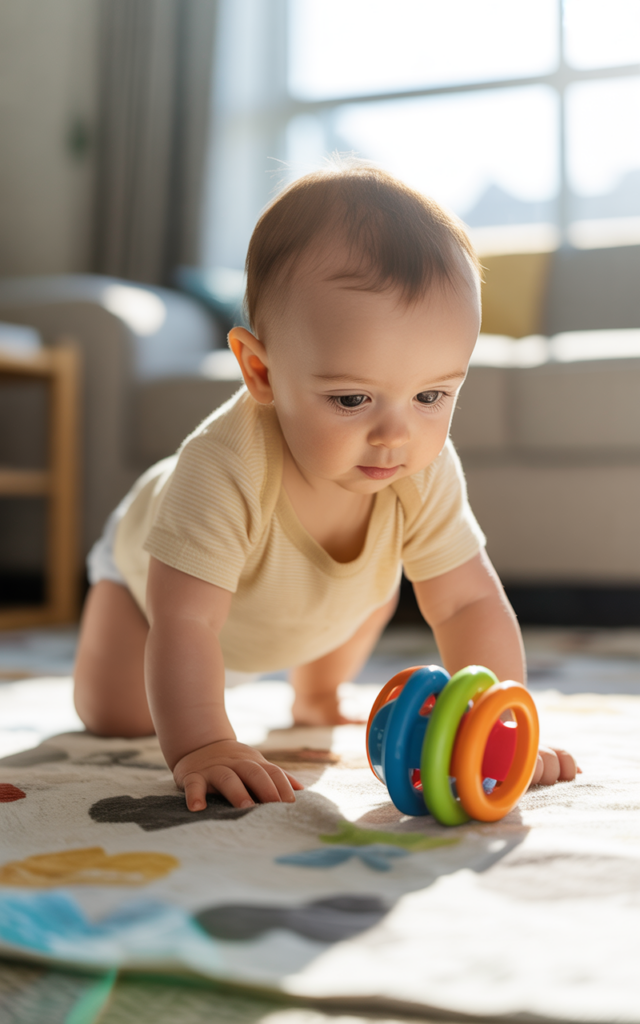
The final quarter of your baby’s first year showcases remarkable cognitive abilities. She’s no longer a passive observer. She actively tests ideas, solves problems, and makes plans. Her personality becomes more apparent as her thinking becomes more complex.
Goal-Directed Behavior
Your baby now performs actions with specific goals in mind. She’ll crawl across the room to get a particular toy. She’ll pull herself up to reach something on a table. These aren’t random movements. They’re planned sequences of actions aimed at achieving a desired result. This goal-oriented behavior requires mental planning that wasn’t present months ago.
She understands that obstacles can be removed. If a box blocks her path to a toy, she’ll move the box. If she can’t reach something, she’ll look for something to stand on. This problem-solving shows sophisticated thinking about how to manipulate her environment.
Tool Use
Basic tool use emerges during these months. Your baby might use a spoon to bang on a pot or use a stick to reach a toy. She’s learning that objects can be used to accomplish goals. This understanding of tools as extensions of her own abilities marks a cognitive milestone.
Understanding Commands
Language comprehension expands rapidly. Your baby understands simple requests like “come here” or “give me that.” She responds to questions with actions. Ask “where’s your nose?” and she might point to it. These responses show she’s connecting words with concepts.
First words often appear near the end of this period. “Mama,” “dada,” and “no” are common early words. Each word represents a cognitive achievement. Your baby has connected a sound pattern with a specific person, object, or concept.
Social Observation
Your baby watches other people carefully and learns from what she sees. She notices how you open doors, turn on lights, or use the phone. Then she tries to copy these actions. This social learning shows she understands that actions have purposes and that watching others is a valuable way to learn.
She also starts to understand joint attention. When you point at something, she looks where you’re pointing instead of at your finger. This shows she grasps that you’re directing her attention to something specific. Joint attention is crucial for language development and social learning.
Below some important cognitive skills at this stage:
Sequential Thinking: She performs actions in order to reach a goal.
Category Formation: She groups similar objects together mentally.
Means-End Understanding: She knows that certain actions lead to specific results.
Social Referencing: She looks to you for cues about how to react to new situations.
Memory Sophistication
Memory becomes quite sophisticated. Your baby remembers people she saw weeks ago. She recalls how to play with toys she hasn’t seen recently. She knows where things belong and might try to put them back in their places. This long-term memory supports all her learning.
She also develops working memory. She can hold information in mind while doing something else. For example, she might remember she was heading to get a toy even after being briefly distracted by something else along the way.
13-18 Months: Symbolic Thinking Emerges
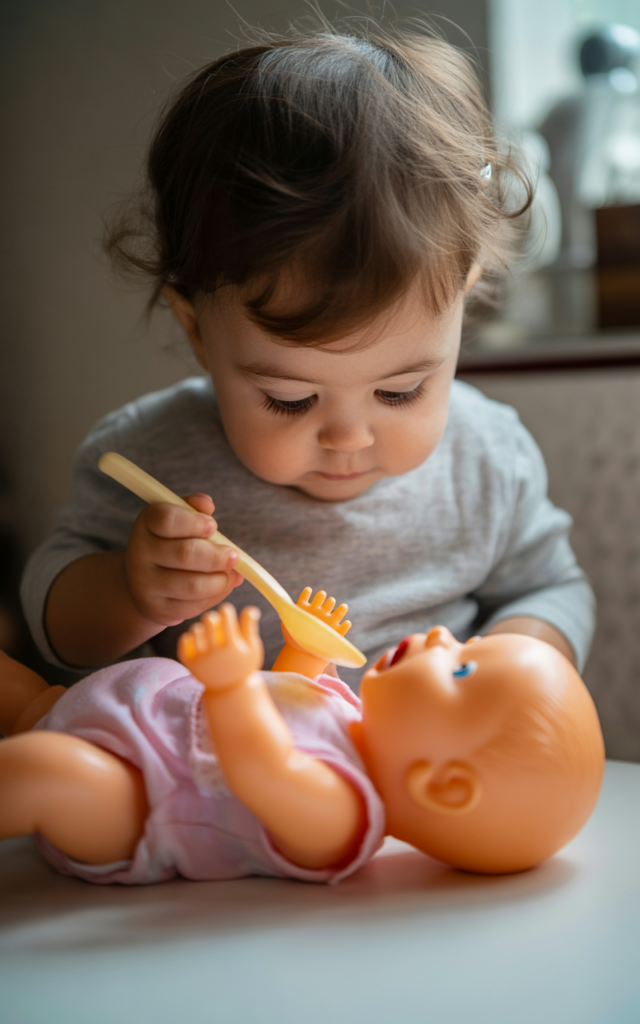
After your child’s first birthday, her cognitive abilities take another leap. She begins to understand that one thing can represent another. This symbolic thinking opens doors to new forms of learning and play. Pretend play emerges as she uses this new mental skill.
Pretend Play Begins
Your toddler starts to engage in simple pretend scenarios. She might pretend to feed a doll or talk on a toy phone. This play shows she can hold two ideas in mind simultaneously. The toy phone is both an object and a representation of a real phone. This mental flexibility is a major cognitive achievement.
She imitates daily routines during play. She might pretend to sweep the floor, cook food, or put a baby to bed. These scenarios show she’s processing and remembering the activities she observes. Play becomes a way to practice and understand the world around her.
Language Explosion
Vocabulary grows rapidly during this period. Many children add several new words each week. Your toddler starts combining two words to make simple sentences. “More juice” or “daddy go” show she understands basic grammar rules. Language and cognitive development support each other. Each new word gives her a tool to think more complex thoughts.
Problem-Solving Skills
Problem-solving becomes more advanced. Your child will try multiple strategies to solve a problem. She might use trial and error less and thinking more. Before acting, she pauses to consider options. This mental planning shows growing cognitive sophistication.
She begins to understand categories and can group similar items. All round things go together. All animals are different from toys. This categorization helps her organize information and make sense of her increasingly complex world.
Self-Awareness
Self-awareness develops during these months. Your toddler recognizes herself in mirrors and photos. She knows she’s a separate person from you. This self-concept affects how she thinks about herself in relation to others.
Understanding Sequences
Your child grasps simple sequences and routines. She knows that bath time comes before bed. She expects certain things to happen in a particular order. Disruptions to these routines might upset her because she’s developed expectations based on patterns she’s observed.
She also understands simple cause-and-effect relationships better. She knows that pressing a light switch makes the light come on. She realizes that putting on her coat means going outside. These connections show increasingly sophisticated thinking about how the world works.
Memory and Planning
Memory continues to strengthen. Your toddler remembers events from weeks ago. She recalls where things are kept and looks for them in the right places. She might anticipate upcoming events and show excitement or concern.
She starts to make simple plans. She might get her shoes when she wants to go outside. She brings you a book when she wants a story. These actions show she’s thinking ahead and taking steps toward goals.
19-24 Months: Advanced Problem Solving
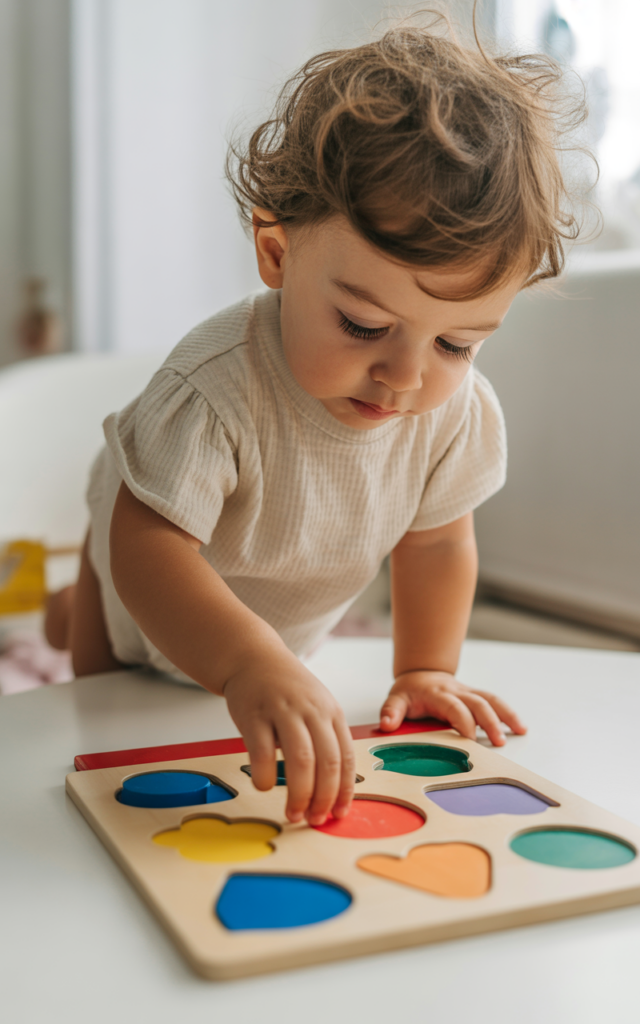
The second half of your child’s second year brings impressive cognitive growth. Her thinking becomes more flexible and creative. She can solve problems in multiple ways and understand increasingly complex concepts. Abstract thinking begins to emerge.
Complex Pretend Play
Pretend play grows more elaborate. Your toddler might create scenarios with multiple steps. She feeds a doll, puts it to bed, then wakes it up. These sequences show planning and memory. She’s also starting to understand that different people have different perspectives, a skill called theory of mind.
Sorting and Matching
Your child becomes skilled at sorting objects by different characteristics. She can group by color, size, or type. She matches shapes to cutouts and completes simple puzzles. These activities require mental manipulation of information. She must hold criteria in mind while evaluating objects.
She understands one-to-one correspondence. She knows that each person needs one plate or one cup. This mathematical thinking shows cognitive development beyond simple counting. She grasps relationships between quantities.
Language as a Cognitive Tool
Language becomes a powerful cognitive tool. Your toddler uses words to think through problems. She might talk herself through tasks. She asks “why” questions constantly, seeking to understand cause and effect. These questions show active thinking about how things work.
Two and three-word sentences become common. She can describe what she wants and what she’s doing. She tells you about things that happened earlier. This ability to communicate about events not happening right now shows mental time travel. She can think about the past and anticipate the future.
Below are key cognitive abilities at this stage:
Symbolic Representation: She uses objects, actions, or words to stand for other things.
Multi-Step Planning: She can plan and execute actions with several steps.
Perspective Taking: She begins to understand that others see and think differently than she does.
Abstract Thinking: She starts to grasp concepts that aren’t physically present.
Understanding Concepts
Abstract concepts begin to make sense. Big and small, hot and cold, fast and slow—these comparative ideas require mental processing. Your toddler starts to use these words correctly. She’s not just naming properties but understanding relationships between objects.
She grasps simple time concepts. She understands “later” and “yesterday,” though she might not use them accurately yet. She anticipates future events and remembers past ones. This temporal thinking shows sophisticated cognitive development.
Problem-Solving Creativity
Problem-solving becomes more creative. Your toddler tries unconventional solutions. She might stack blocks to reach something high or push a chair to climb up. She’s not limited to obvious solutions. She thinks about problems from different angles.
She learns from watching others solve problems. She doesn’t need to try every solution herself. She can observe, understand, and apply someone else’s method. This observational learning saves time and shows cognitive efficiency.
Your Child’s Cognitive Path Forward
Watching your baby’s mental growth from newborn reflexes to complex problem-solving is remarkable. Each stage builds on previous learning. The skills your child develops in these first two years create the foundation for all future thinking and learning. Your role in this development matters more than any educational toy or program.
Simple daily interactions provide the richest learning opportunities. Talking to your child, reading books together, and allowing free play support cognitive growth better than structured activities. Your consistent presence, attention, and responses to your baby’s needs create the secure environment that allows her brain to focus on learning rather than survival. Trust the process and enjoy each phase of discovery.
Frequently Asked Questions
Q: How can I tell if my baby’s cognitive development is on track?
A: Watch for age-appropriate milestones like recognizing faces by two months, looking for hidden objects by nine months, and following simple commands by one year. Every baby develops at their own pace, but missing several milestones might warrant a conversation with your pediatrician.
Q: Does screen time affect cognitive development in babies?
A: Research suggests that excessive screen time before age two can interfere with cognitive development. Babies learn best through hands-on experiences and face-to-face interactions. The American Academy of Pediatrics recommends avoiding screens for children under 18 months except for video chatting.
Q: What activities best support cognitive development in the first year?
A: Simple activities work best. Talk to your baby throughout the day, read books together, play peekaboo, and provide safe objects to explore. Responsive interactions where you follow your baby’s lead are more valuable than structured learning programs.
Q: Should I be concerned if my baby isn’t talking by 12 months?
A: Many babies don’t say their first words until after their first birthday. Focus on whether your baby understands simple words and commands and whether she’s communicating through gestures and sounds. If she’s not responding to her name or showing interest in communication by 12 months, consult your pediatrician.
Q: How does cognitive development relate to physical development?
A: The two are closely connected. Physical skills like crawling and reaching allow babies to interact with their environment, which supports cognitive growth. Similarly, cognitive development motivates babies to move and act in new ways.
Q: Can I speed up my baby’s cognitive development?
A: You can’t rush development, but you can provide rich experiences that support learning. Focus on responsive caregiving, plenty of interaction, and a safe environment for exploration rather than trying to accelerate specific milestones.
Q: What role does sleep play in cognitive development?
A: Sleep is crucial for cognitive development. During sleep, babies consolidate memories and process information they learned while awake. Consistent sleep routines support healthy brain development and learning.
Q: Are there warning signs of cognitive delays I should watch for?
A: Concerning signs include not making eye contact by three months, not showing interest in faces or toys, not responding to sounds, or not showing progress in learning new skills. Trust your instincts and talk to your pediatrician about any concerns.