Watching your baby discover the world through their senses creates some of the most magical moments of early parenthood. Those tiny fingers exploring different textures, wide eyes tracking colorful objects, and excited reactions to new sounds all signal important brain development happening right before your eyes. Each sensory experience your baby encounters literally builds the architecture of their developing brain, creating neural pathways that will support learning throughout their entire life.
The first year of life represents an incredible period of brain growth, with your baby’s brain doubling in size and forming millions of neural connections every single day. Sensory activities provide the raw materials for this remarkable construction project. Through simple play experiences that engage sight, sound, touch, movement, and even taste, you’re giving your baby’s brain the stimulation it needs to develop cognitive skills like memory, problem-solving, and attention. These activities don’t require expensive equipment or complicated setups – many of the most effective sensory experiences come from everyday household items and natural interactions.
Research shows that babies who engage in regular sensory play demonstrate stronger cognitive abilities, better emotional regulation, and enhanced motor skills as they grow. The beauty lies in how naturally these activities fit into your daily routine. Whether you’re splashing during bath time, crinkling paper during a diaper change, or making funny sounds during feeding, you’re already supporting your baby’s cognitive development. Let’s explore ten simple yet powerful sensory activities that will nurture your baby’s growing mind while creating joyful bonding moments together.
- What Makes Sensory Play Essential for Baby Brain Development?
- Which Simple Touch Activities Build Neural Connections?
- How Do Visual Sensory Activities Support Cognitive Growth?
- What Sound Activities Enhance Auditory Processing?
- Which Movement Activities Boost Spatial Awareness?
- Finding Joy in Simple Sensory Discoveries
- Frequently Asked Questions
What Makes Sensory Play Essential for Baby Brain Development?
Your baby’s brain arrives primed for learning, with billions of neurons waiting to form connections through sensory experiences. Every texture they touch, sound they hear, and sight they take in triggers electrical signals that travel through their nervous system, strengthening neural pathways with each repetition. This process, called synaptogenesis, happens most rapidly during the first three years of life, making early sensory experiences particularly powerful for cognitive development.
The connection between senses and neural pathways
Think of your baby’s brain as a city being built from scratch. Sensory experiences act like construction crews, laying down roads (neural pathways) that connect different neighborhoods (brain regions). The more a particular road gets used, the stronger and faster it becomes. When your baby repeatedly experiences different textures, their brain builds stronger connections between the sensory cortex and other brain areas responsible for memory, language, and reasoning.
Scientists have discovered that babies who receive varied sensory input show increased activity in multiple brain regions simultaneously. This cross-activation helps different areas of the brain learn to work together, forming the foundation for complex cognitive tasks later in life. A simple activity like letting your baby handle a bumpy rubber ball activates not just the touch centers, but also areas controlling motor planning, spatial awareness, and visual processing.
Critical windows for sensory development
Certain periods in your baby’s first year represent optimal times for specific types of sensory learning. During the first three months, high-contrast visual stimulation supports the development of the visual cortex. Between four and six months, tactile exploration becomes crucial as babies gain better hand control. From seven to twelve months, combining multiple senses through activities creates richer learning experiences.
Missing these windows doesn’t mean development stops, but providing appropriate sensory input during these sensitive periods maximizes your baby’s cognitive potential. The brain shows remarkable plasticity during infancy, meaning it can reorganize and adapt based on the experiences you provide.
How different textures stimulate cognitive growth
Texture exploration does more than just satisfy your baby’s curiosity. Each new surface they encounter requires their brain to process and categorize the sensation, building cognitive skills like discrimination and classification. Smooth silk feels different from rough burlap, teaching your baby that objects have distinct properties. This early categorization ability forms the basis for later academic skills like sorting, comparing, and contrasting.
When babies explore textures, they’re also developing what researchers call “haptic perception” – the ability to understand objects through touch. This skill connects directly to spatial reasoning and mathematical thinking. Studies show that infants who engage in regular texture play demonstrate better problem-solving abilities and spatial awareness as toddlers.
The role of repetition in strengthening connections
You might notice your baby wants to repeat the same sensory activity over and over. This repetition isn’t random – it’s your baby’s brain deliberately strengthening important neural connections. Each time they experience a familiar sensation, the associated neural pathway becomes more efficient, like wearing a path through grass by walking the same route repeatedly.
Repetition also helps babies build predictive models of their world. When they shake a rattle for the hundredth time, they’re confirming their understanding that certain actions produce specific results. This cause-and-effect learning forms the foundation for logical thinking and scientific reasoning. The key lies in providing enough repetition for mastery while introducing variations to keep learning active.
Signs your baby is ready for sensory activities
Every baby develops at their own pace, but certain behaviors signal readiness for different types of sensory play. Newborns who can focus on objects for several seconds benefit from simple visual activities. Babies who bring objects to their mouth (usually around 4-6 months) are ready for safe taste and texture exploration. When your baby starts reaching and grasping purposefully, they’re prepared for more complex tactile experiences.
Watch for your baby’s engagement cues too. Alert, wide eyes and calm breathing indicate optimal learning state. Turning away, fussing, or closing eyes suggests overstimulation. Learning to read these signals helps you provide sensory experiences at just the right level of challenge – engaging enough to promote growth without overwhelming your baby’s developing nervous system.
Which Simple Touch Activities Build Neural Connections?
Touch represents your baby’s most developed sense at birth, making tactile activities particularly powerful for early cognitive development. The skin contains millions of receptors that send information directly to the brain, helping babies understand boundaries, temperature, pressure, and texture. Through intentional touch experiences, you’re literally helping wire your baby’s brain for learning, emotional regulation, and social connection.
Textured fabric squares exploration
Creating a collection of fabric squares with varying textures provides endless opportunities for tactile learning. Gather materials like velvet, corduroy, satin, terrycloth, fleece, and denim, cutting them into 6-inch squares for easy handling. During supervised play, let your baby touch, grasp, and manipulate these different textures while you describe what they’re feeling: “This velvet feels so soft” or “The corduroy has little ridges.”
As your baby explores each fabric, their brain processes multiple properties simultaneously – temperature, roughness, flexibility, and weight. This multi-dimensional processing strengthens connections between different brain regions. You can enhance the experience by gently rubbing different fabrics on your baby’s arms, legs, and cheeks (always watching for their comfort level), helping them develop body awareness alongside tactile discrimination.
For younger babies who aren’t yet grasping objects, create a texture mat by securely sewing different fabric squares onto a larger piece of backing material. Place your baby on their tummy or back on this mat during supervised play time. The varied sensations against their skin stimulate nerve endings throughout their body, promoting overall sensory integration.
Water play with different temperatures
Water offers unique sensory properties that fascinate babies while supporting cognitive development. Start with simple warm water play during bath time, letting your baby splash and feel the liquid moving around their body. The unpredictable nature of water movement challenges their brain to constantly process new sensory information, strengthening adaptive thinking skills.
As your baby grows more comfortable, introduce temperature variations using two small containers – one with slightly warm water and one with cool (never cold) water. Let them dip their fingers alternately between containers while you narrate the experience. This temperature discrimination helps develop sensory processing abilities that contribute to later safety awareness and decision-making skills.
Add cognitive complexity by introducing objects that float or sink, pour or spray. A simple cup for pouring teaches cause and effect, volume concepts, and motor planning. Squeeze toys that spray water help babies understand pressure and force. These water-based activities engage multiple senses simultaneously – touch, sight, and sometimes sound – creating rich neural connections that support integrated learning.
Soft brushing techniques for sensory awareness
Gentle brushing activities provide organized sensory input that many babies find calming while promoting neural development. Using a soft infant hairbrush, clean paintbrush, or makeup brush, lightly stroke your baby’s arms, legs, hands, and feet with long, smooth movements. This type of touch input helps organize the nervous system and can improve attention and focus.
Pay attention to your baby’s responses to determine their preferences. Some babies enjoy firm, predictable strokes, while others prefer lighter touch. The key lies in maintaining consistent rhythm and pressure, which helps the brain recognize and process patterns. This pattern recognition ability transfers to other cognitive skills like understanding sequences, recognizing routines, and eventually, learning language patterns.
You can turn brushing into a cognitive game by brushing different body parts while naming them: “Now I’m brushing your tiny toes” or “Here comes the brush on your arm.” This combines tactile input with language exposure, strengthening connections between sensory and language centers in the brain.
Creating a touch-and-feel book at home
Homemade sensory books provide portable tactile experiences that grow with your baby’s developing abilities. Start with a simple photo album or sturdy cardboard pages. Attach different materials to each page using strong, non-toxic glue: sandpaper, aluminum foil, bubble wrap, fake fur, rubber shelf liner, and cotton balls all make excellent choices.
Each page presents a new cognitive challenge as your baby learns to anticipate and remember different textures. Their brain works to recall previous experiences with each material, strengthening memory pathways. You might notice your baby showing preferences or avoiding certain textures – these reactions indicate developing cognitive abilities like comparison, preference formation, and decision-making.
As your baby develops, add complexity by grouping similar textures together or creating patterns. For instance, alternate smooth and rough textures across pages, helping your baby recognize patterns and sequences. This early pattern recognition supports later mathematical thinking and logical reasoning skills.
Finger painting with edible materials
Sensory-safe finger painting allows babies to explore texture, temperature, and movement while creating visual feedback for their actions. Mix instant pudding, yogurt with food coloring, or pureed fruits for completely safe “paint” options. Spread a thin layer on a highchair tray or place your baby in just a diaper on a washable surface.
The cognitive benefits extend beyond simple sensory input. As babies move their hands through the medium, they’re developing spatial awareness and cause-and-effect understanding. They learn that their movements create marks, that pressing harder creates different effects, and that mixing colors produces new ones. These discoveries build scientific thinking skills and creative problem-solving abilities.
Watch as your baby experiments with different movements – patting, swirling, dragging fingers, or using their whole palm. Each technique requires different motor planning and produces different results, teaching your baby about variation and choice. This exploratory process mirrors the scientific method: hypothesis (what happens if I do this?), experiment (trying the action), and observation (seeing the result).
How Do Visual Sensory Activities Support Cognitive Growth?
Vision develops rapidly during your baby’s first year, with visual experiences directly shaping how the brain processes and interprets information. Unlike touch, which is well-developed at birth, vision requires extensive practice and stimulation to reach its full potential. Strategic visual activities during this critical period help establish neural pathways for pattern recognition, spatial reasoning, and attention – cognitive skills that form the foundation for reading, mathematics, and problem-solving.
Black and white pattern cards for newborns
During the first three months, babies see best when objects are 8-12 inches from their face and feature high contrast. Black and white patterns provide the optimal visual stimulation for developing eyesight and brain connections. Create simple cards with bold geometric shapes, stripes, checkerboards, and spirals using black marker on white cardstock.
These high-contrast images help strengthen the connection between your baby’s eyes and brain, particularly the visual cortex. As your baby stares at these patterns, their brain works to make sense of edges, shapes, and boundaries – fundamental skills for later object recognition and reading. The effort required to focus on and track these images also strengthens eye muscles and coordination.
Change the cards every few days to maintain interest and challenge developing visual skills. You might notice your baby showing preferences for certain patterns – curved lines versus straight, simple versus complex. These preferences indicate cognitive development as their brain becomes better at processing visual information and forming opinions based on past experiences.
Position cards at the side of the changing table, attach them to the crib (safely out of reach), or hold them during tummy time. The variety of viewing angles helps your baby’s brain learn to recognize patterns from different perspectives, building cognitive flexibility and spatial intelligence.
Mirror play for self-recognition development
Mirrors provide fascinating visual feedback that supports both cognitive and emotional development. While babies won’t recognize themselves until around 18 months, early mirror play builds important neural pathways for self-awareness, social understanding, and visual tracking.
Start by holding your baby in front of a mirror during calm, alert periods. Watch as they study the “other baby” with intense concentration. Their brain is working hard to process this complex visual information – movement that corresponds with their own feelings of movement, facial expressions that change in real-time, and the presence of familiar caregivers in an unusual format.
Make mirror time interactive by playing peek-a-boo, making different facial expressions, or moving toys in front of the mirror. These activities help your baby understand relationships between objects, develop depth perception, and learn about cause and effect. The cognitive challenge of processing reflected images strengthens visual processing centers and their connections to other brain regions.
Unbreakable acrylic mirrors placed at floor level during tummy time encourage longer periods of head lifting and visual exploration. This combination of physical and visual challenge creates rich learning experiences that support both motor and cognitive development. The sustained attention required for mirror gazing also helps develop focus and concentration abilities.
Light and shadow exploration games
Playing with light and shadows introduces babies to concepts of presence and absence, cause and effect, and spatial relationships. These activities stimulate the visual cortex while engaging problem-solving areas of the brain. Start simple with a flashlight in a darkened room, moving the light slowly across walls and ceiling while your baby tracks the movement.
Create shadow puppets using your hands or simple cut-out shapes. Your baby’s brain must process that the shadow and the object creating it are related but separate – a complex cognitive task that builds abstract thinking abilities. As they watch shadows move and change size, they’re learning about perspective, distance, and transformation.
During daytime, position your baby where they can see shadows from windows moving across the room. This natural light play helps them understand time passage and environmental changes. Their developing brain begins to recognize patterns in how shadows shift throughout the day, building early understanding of sequences and cycles.
For older babies, let them create their own shadows using safe objects and a lamp or window light. The discovery that they can control shadow creation represents a significant cognitive leap in understanding their own agency and impact on the environment.
Bubble watching for tracking skills
Bubbles offer a perfect combination of visual stimulation and unpredictability that challenges developing cognitive abilities. The slow, floating movement of bubbles allows babies to practice smooth visual tracking – following objects with their eyes rather than jerky movements. This skill directly supports later reading ability and attention span.
As babies watch bubbles form, float, and pop, their brain processes multiple concepts simultaneously: object permanence (bubbles exist then disappear), trajectory prediction (where the bubble might float), and cause and effect (blowing creates bubbles). These observations build scientific thinking and prediction skills.
The iridescent surface of bubbles provides additional visual complexity as colors shift and swirl. This color play stimulates different cone cells in the retina and corresponding processing areas in the brain. Your baby’s attempts to reach for or pop bubbles also integrate visual information with motor planning, strengthening connections between visual and motor cortices.
Vary the bubble experience with different sizes and speeds. Bubble machines create steady streams for sustained attention practice, while hand-blown bubbles allow for interactive play. Some babies prefer watching from a distance, while others want to be in the middle of the bubble shower – both approaches offer valuable learning experiences.
Color discovery bottles for older babies
Around 4-6 months, babies begin distinguishing colors beyond black and white, making color exploration valuable for cognitive development. Create discovery bottles using clear plastic bottles filled with colored water, oil and food coloring for a lava lamp effect, or water with glitter and small colorful objects.
These bottles serve multiple cognitive purposes beyond color recognition:
- Visual Tracking: Following objects as they move through liquid
- Prediction Skills: Anticipating where floating objects will go
- Cause and Effect: Understanding that shaking creates movement
- Sustained Attention: Watching slow-moving liquids requires focus
As your baby manipulates these bottles, they’re conducting early science experiments. They learn that tilting changes the flow, shaking creates bubbles, and different liquids move at different speeds. This hands-on investigation builds the cognitive framework for scientific thinking and experimentation.
Create themed bottles for different learning experiences – a “beach” bottle with sand and shells, a “garden” bottle with artificial flowers and green water, or a “space” bottle with silver stars in dark blue liquid. Each theme introduces new vocabulary and concepts while maintaining visual engagement. The contained nature of bottle activities also teaches boundaries and safety, as babies learn they can explore freely within defined limits.
What Sound Activities Enhance Auditory Processing?
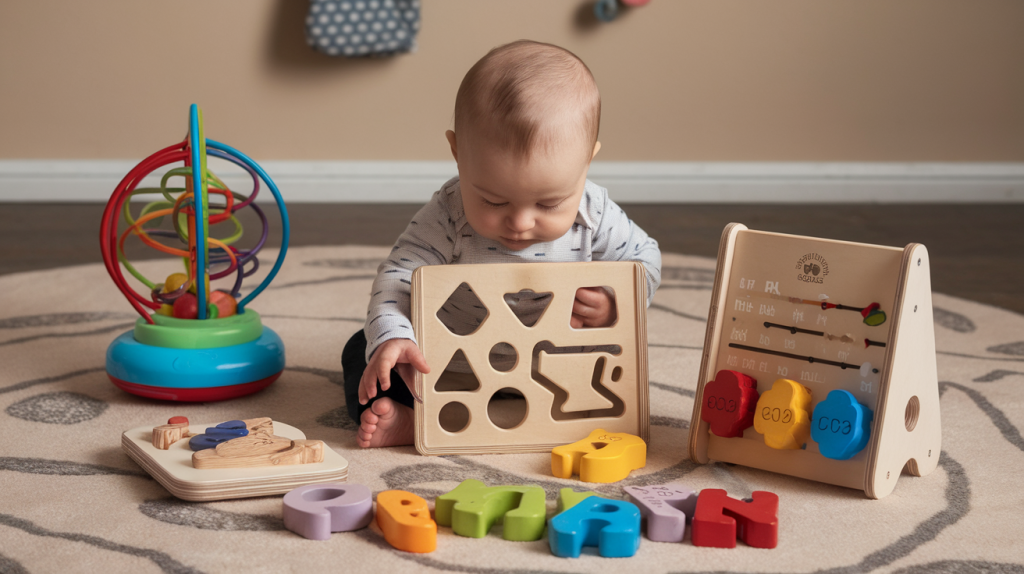
Your baby’s auditory system began functioning long before birth, making sound one of the most familiar sensory experiences for newborns. However, the brain’s ability to process, discriminate, and attach meaning to sounds continues developing throughout the first year. Sound activities strengthen neural pathways between the auditory cortex and language centers, memory regions, and emotional processing areas, laying groundwork for communication, musical ability, and cognitive skills like pattern recognition and sequential processing.
Musical shakers from household items
Creating homemade shakers introduces your baby to cause-and-effect relationships while developing auditory discrimination skills. Fill small, secure containers with different materials – rice, beans, bells, or beads – ensuring lids are firmly sealed with strong tape. Each shaker produces distinct sounds that help your baby’s brain learn to differentiate between various auditory inputs.
When your baby shakes these instruments, multiple cognitive processes activate simultaneously. Their brain must coordinate motor planning with auditory feedback, strengthening connections between motor and auditory cortices. They learn that harder shaking produces louder sounds, faster shaking creates different rhythms, and different containers yield unique tones. These discoveries build early physics understanding and mathematical concepts like volume, speed, and intensity.
Introduce rhythm patterns by shaking along to simple songs or creating call-and-response games. Shake twice, then wait for your baby to attempt copying. This imitation game develops working memory, attention, and sequential processing – cognitive skills essential for language development and academic learning. Start with simple patterns and gradually increase complexity as your baby’s abilities grow.
The predictability of shaker sounds also provides cognitive comfort. Unlike unpredictable environmental noises, shakers produce consistent sounds that help babies feel in control of their sensory environment. This sense of control supports emotional regulation and confidence in exploration.
Voice recording playback games
Your voice represents the most important sound in your baby’s world, and recording technology offers unique opportunities to use this familiar sound for cognitive development. Record yourself singing, talking, or making silly sounds, then play these recordings during different activities. Your baby’s brain must work to recognize your voice without visual cues, strengthening auditory processing and memory.
Create simple audio games by recording family members saying your baby’s name or familiar words. Play these recordings and watch your baby’s reactions – they’re demonstrating voice recognition and auditory memory. This ability to identify and remember specific voices forms the foundation for language discrimination and social bonding.
Recording your baby’s own vocalizations and playing them back creates a fascinating cognitive challenge. Babies often show surprise or confusion hearing their own sounds, indicating developing self-awareness. As they begin to recognize their own voice, they’re building neural pathways for self-recognition and identity formation.
Use recordings to maintain familiar voices during separations. A recording of you singing a favorite lullaby can provide comfort while simultaneously exercising auditory memory and emotional regulation. This multi-sensory approach – hearing familiar sounds while experiencing different visual environments – helps babies develop cognitive flexibility.
Nature sounds exploration
Natural sounds offer rich auditory experiences that differ significantly from household noises or music. Take your baby outside to hear birds chirping, leaves rustling, or water flowing. These organic sounds contain complex frequencies and patterns that challenge the auditory system in unique ways.
Indoor nature sound exploration works too. Play recordings of ocean waves, rainfall, or forest sounds during quiet playtime. These sounds often contain white noise properties that can calm babies while still providing auditory stimulation. Your baby’s brain learns to identify and categorize these environmental sounds, building cognitive schemas for different settings and conditions.
Create sound-matching games using nature sound apps or recordings. Play a bird chirp, then show your baby a picture or toy bird. This multi-sensory connection strengthens associations between sounds and their sources, supporting categorical thinking and memory formation. As cognitive abilities develop, add complexity by introducing similar but distinct sounds – different bird calls, various water sounds – challenging auditory discrimination skills.
The irregular patterns in nature sounds also benefit cognitive development differently than musical rhythms. Wind doesn’t blow steadily; birds don’t chirp in perfect time. Processing these variable patterns helps develop cognitive flexibility and adaptation skills.
Rhythm and clapping exercises
Rhythmic activities engage multiple brain regions simultaneously, making them powerful tools for cognitive development. Simple clapping games help babies understand patterns, sequences, and timing – fundamental concepts for mathematics, language, and music.
Start with basic clapping to songs or nursery rhymes. Your baby watches your hands, hears the sound, and feels the vibration if you’re holding them. This multi-sensory input creates rich neural connections. As coordination develops, help your baby clap their own hands or pat their legs, adding motor planning to the cognitive mix.
Introduce variety through different clapping patterns:
- Steady beats: Building understanding of consistency and time
- Fast and slow: Teaching tempo and comparison
- Loud and soft: Developing volume discrimination
- Patterns: Two claps, pause, one clap – building sequence recognition
These variations require your baby’s brain to process and anticipate patterns, strengthening predictive processing abilities. The anticipation of the next clap in a pattern exercises working memory and attention, while successfully predicting patterns provides cognitive reward that encourages continued learning.
Cultural rhythm games from around the world offer additional cognitive benefits. Different cultural rhythms introduce unusual patterns that challenge Western-trained ears, promoting cognitive flexibility and openness to diverse inputs. This early exposure to rhythmic diversity may support later language learning and musical abilities.
Silent moments for sound differentiation
Deliberate quiet periods might seem counterintuitive for auditory development, but silence actually enhances sound processing abilities. During quiet moments, your baby’s brain can process subtle environmental sounds usually masked by louder noises – the refrigerator humming, clock ticking, or distant traffic.
Create “listening minutes” where you sit quietly with your baby, drawing attention to different sounds as they occur. Whisper identification of sounds: “That’s a dog barking” or “The washing machine is spinning.” This focused listening develops selective attention – the ability to isolate and identify specific sounds from background noise.
Silence also allows your baby’s auditory system to reset and recover from stimulation. Just as eyes need to look away from bright lights, ears benefit from breaks in sound input. These quiet periods help prevent sensory overload and support better processing of sounds when they return.
The contrast between sound and silence teaches important cognitive concepts. Your baby learns that sound has absence as well as presence, that quiet can be comfortable, and that they can control some sounds through their own vocalizations. This understanding of contrast and control supports emotional regulation and environmental awareness.
Which Movement Activities Boost Spatial Awareness?
Movement experiences during infancy shape far more than just physical development. As your baby moves through space, their brain constructs mental maps of their environment, develops understanding of their body in relation to objects, and builds the spatial intelligence necessary for everything from navigation to mathematics. These movement-based sensory activities strengthen connections between the vestibular system (balance), proprioceptive system (body awareness), and higher cognitive centers.
Tummy time variations with sensory elements
Traditional tummy time becomes a rich cognitive experience when combined with sensory elements. Place different textured materials under your baby during tummy time – a silk scarf, rubber mat, or soft blanket. As they push up and move, they receive tactile feedback that helps map their body boundaries and understand how their movements affect their position in space.
Position interesting objects at various distances during tummy time to encourage reaching and visual depth perception. A mirror to one side, a musical toy slightly ahead, and a textured ball within reach create a sensory environment that motivates movement while building spatial understanding. Your baby’s brain must calculate distances, plan movements, and adjust based on feedback – complex cognitive tasks disguised as play.
The effort required to lift their head and chest during tummy time doesn’t just strengthen muscles; it activates the vestibular system in the inner ear. This system sends signals to the brain about head position and movement, helping develop balance, coordination, and spatial orientation. These vestibular inputs connect to areas of the brain responsible for attention, emotional regulation, and even mathematical reasoning.
For babies who resist traditional tummy time, try positioning them on your chest while you recline, or use a nursing pillow for support. The slight elevation changes the spatial challenge while maintaining cognitive benefits. Adding gentle rocking or swaying while your baby is on their tummy introduces additional vestibular input that enhances spatial processing.
Rolling games with textured balls
Rolling activities combine visual tracking, motor planning, and spatial prediction in ways that significantly boost cognitive development. Start with balls of different sizes and textures – a bumpy rubber ball, smooth plastic ball, and soft fabric ball each provide unique sensory feedback and movement patterns.
When you roll a ball to your baby, their brain performs complex calculations to predict its path, speed, and arrival time. These predictions strengthen neural pathways involved in mathematical thinking and physics understanding. Even before they can catch the ball, watching and anticipating its movement builds cognitive skills.
As your baby begins attempting to push or bat at balls, they’re learning about force, direction, and consequence. A gentle tap sends the ball one way; a harder hit sends it farther. These early experiments with cause and effect lay groundwork for scientific thinking and problem-solving abilities.
Create rolling games with variations that challenge different cognitive skills. Roll balls down ramps to introduce concepts of gravity and acceleration. Use musical balls that chime when moved to add auditory processing to the spatial challenge. Hide balls partially under blankets to work on object permanence while maintaining the movement element.
Assisted bouncing on different surfaces
Supported bouncing provides intense vestibular and proprioceptive input that significantly impacts cognitive development. Hold your baby securely under their arms and gently bounce them on different surfaces – your bed, a firm couch, or an exercise ball. Each surface provides different resistance and rhythm, challenging your baby’s brain to adapt and predict.
The rhythmic nature of bouncing helps organize the nervous system and can improve attention and focus. Many babies who seem overstimulated or fussy calm down with gentle, rhythmic bouncing. This organizing effect on the nervous system creates optimal conditions for learning and cognitive processing.
Vary bouncing patterns to increase cognitive challenge:
- Steady rhythm: Builds pattern recognition and timing
- Alternating speeds: Develops adaptation and flexibility
- Counting bounces: Introduces early number concepts
- Bouncing to music: Integrates auditory and vestibular processing
During bouncing, your baby’s brain constantly adjusts to maintain balance and position. This continuous adjustment strengthens connections between the cerebellum (coordination center) and other brain regions. Research shows strong connections between vestibular development and later academic skills, particularly reading and mathematics.
Reaching exercises with hanging objects
Suspended objects create three-dimensional spatial challenges that flat surfaces can’t provide. Hang safe objects at varying heights using ribbon or elastic cord – just within reach, slightly out of reach, and at different angles. This setup requires your baby to judge distance, plan movements, and adjust their approach based on previous attempts.
The cognitive work involved in successful reaching goes beyond simple motor control. Your baby must maintain visual focus while planning movement, coordinate eyes and hands, and remember what worked before. These executive function skills – planning, working memory, and cognitive flexibility – form the foundation for later academic success.
Change object positions regularly to prevent habituation and maintain cognitive challenge. Moving a familiar toy to a new position requires your baby to update their mental map and adjust their motor plan. This flexibility in thinking and movement supports problem-solving abilities and adaptation skills.
Watch your baby’s problem-solving strategies evolve. Initially, they might swipe randomly. Gradually, they’ll develop more targeted approaches – reaching with one hand, then two, adjusting body position for better angles. Each strategy represents cognitive growth in planning, evaluation, and refinement of approaches.
Body awareness through gentle massage
Infant massage provides proprioceptive input that helps babies understand their body boundaries and position in space. Using gentle, firm pressure, massage your baby’s arms, legs, torso, and back while naming body parts. This combination of touch, pressure, and language builds multiple cognitive connections simultaneously.
During massage, your baby’s brain creates detailed body maps that support spatial intelligence and self-awareness. The predictable sequence of massage – perhaps always starting with legs, moving to arms, then torso – helps develop understanding of sequences and routines. This sequential processing ability supports later skills like following directions, understanding stories, and solving multi-step problems.
Varying massage pressure and speed adds cognitive complexity. Firm pressure provides different proprioceptive input than light touch, helping your baby’s brain distinguish between types of sensory input. Quick movements feel different from slow ones, teaching discrimination and categorization skills.
The focused attention during massage also provides excellent opportunities for cognitive engagement. Make eye contact, sing songs, or play counting games while massaging. This multi-modal input – touch, sound, vision, and sometimes movement – creates rich neural connections that support integrated learning and processing.
Finding Joy in Simple Sensory Discoveries
The journey through your baby’s first year offers countless opportunities to support cognitive development through sensory play. From the gentle touch of different fabrics to the fascinating dance of bubbles floating through air, each sensory experience contributes to the intricate neural architecture developing in your baby’s brain. These ten activities represent just a starting point for the endless possibilities available in everyday moments. The beauty of sensory play lies not in expensive equipment or complicated setups, but in the simple, intentional interactions that happen naturally throughout your day.
The most powerful aspect of these sensory activities is how they transform routine caregiving into brain-building opportunities. Bath time becomes a laboratory for water exploration, diaper changes offer moments for texture discovery, and feeding times provide chances for sound play and interaction. By viewing daily activities through the lens of sensory development, you’ll discover that you’re already providing rich cognitive stimulation without adding extra tasks to your busy schedule. Your loving attention and engagement during these activities matter more than perfect execution – your baby’s brain thrives on the combination of sensory input and emotional connection that you naturally provide.
Frequently Asked Questions
Q: At what age should I start sensory activities with my baby?
A: Sensory activities can begin from birth, starting with simple experiences like gentle touch, soft voices, and high-contrast visual patterns. Newborns benefit from basic sensory input like skin-to-skin contact and looking at black and white patterns. As your baby grows, you can gradually introduce more complex activities based on their developmental readiness and interest level.
Q: How long should sensory play sessions last?
A: Duration depends entirely on your baby’s age and engagement level. Newborns might only tolerate 5-10 minutes of focused sensory play, while older babies can enjoy 15-20 minutes or more. Watch for signs of overstimulation like looking away, fussing, or becoming hyperactive. It’s better to have several short, positive sessions throughout the day than one long session that overwhelms your baby.
Q: Can sensory activities overstimulate my baby?
A: Yes, too much sensory input can overwhelm your baby’s developing nervous system. Signs of overstimulation include crying, turning away, arching their back, or suddenly falling asleep. If you notice these signs, reduce stimulation by moving to a quiet, calm environment. Every baby has different tolerance levels, so learning your baby’s cues helps you provide appropriate amounts of sensory input.
Q: What if my baby doesn’t seem interested in certain sensory activities?
A: Babies have individual preferences and developmental timelines. If your baby shows no interest in an activity, try again in a few weeks. Sometimes adjusting the approach helps – if they dislike finger painting, they might enjoy watching you paint instead. Never force participation; following your baby’s lead ensures positive associations with sensory exploration.
Q: Are store-bought sensory toys better than homemade options?
A: Homemade sensory materials often work just as well as commercial products, sometimes better because you can customize them to your baby’s preferences. Simple household items like empty water bottles filled with rice, fabric scraps, or cardboard boxes provide excellent sensory experiences. The key lies in safety and variety rather than expense.
Q: How do I know if sensory activities are actually helping my baby’s cognitive development?
A: Cognitive development happens gradually and isn’t always immediately visible. Look for subtle signs like increased attention span, more purposeful movements, recognition of familiar objects or sounds, and growing interest in exploration. Your baby might start anticipating favorite activities, showing preferences, or attempting to recreate effects they’ve observed. These behaviors indicate active learning and cognitive growth.
Q: Should I focus on one sense at a time or combine multiple senses?
A: Both approaches have value. Single-sense activities allow focused development of specific neural pathways, while multi-sensory experiences create rich, integrated connections. Start with single-sense activities for very young babies, gradually introducing multi-sensory experiences as they develop. By 6 months, most babies benefit from activities that engage multiple senses simultaneously.
Q: What safety precautions should I take during sensory play?
A: Always supervise sensory activities directly. Ensure materials are non-toxic and too large to pose choking hazards. Check homemade sensory items regularly for wear or damage. Avoid small parts, sharp edges, or materials that could break into dangerous pieces. For water play, never leave your baby unattended even in shallow water. Keep massage oils and lotions away from your baby’s face to prevent ingestion.
Q: Can sensory activities help with sleep and emotional regulation?
A: Certain sensory activities, particularly those involving deep pressure touch, rhythmic movement, or calming sounds, can help organize your baby’s nervous system and promote better sleep patterns. Activities like gentle massage before bedtime, white noise during sleep, or rhythmic rocking can support emotional regulation and sleep quality. However, avoid stimulating sensory play close to bedtime.